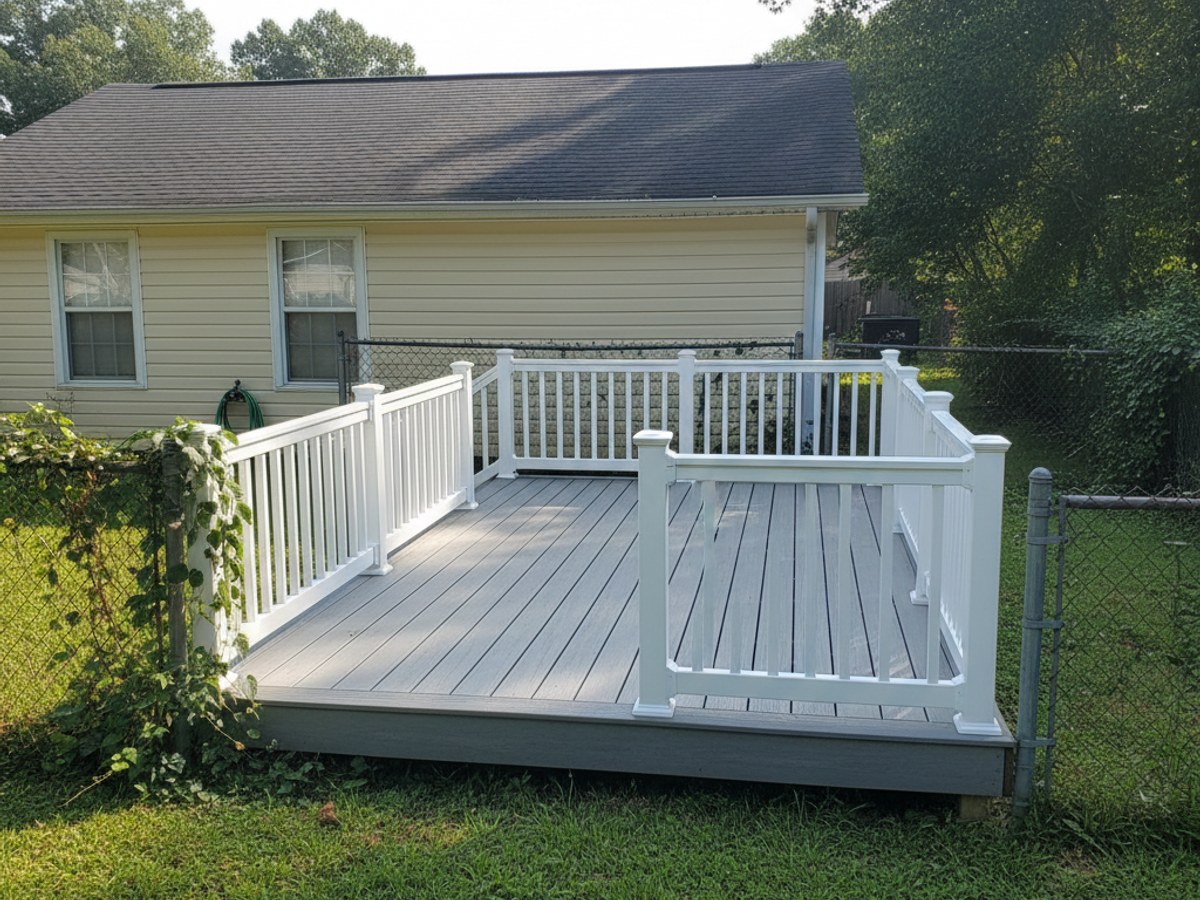
Anybody with a miter saw and a truck can call themselves a deck builder. Most of the time you find out the difference the hard way, usually about three years in, when the ledger board pulls away from the house or the joists start going soft under the boards. Here's what to actually check before you sign a contract, and what should make you walk.
What's happening underground matters more than what's on top
DeSoto County sits on a lot of heavy clay. Clay soil swells when it's wet and shrinks hard when it dries out, and Olive Branch summers can go weeks without rain in July and August while spring brings the opposite problem. A footing that isn't set deep enough or wide enough will move with that clay over a couple of seasons, and a moving footing means a deck that starts to rack, doors that won't close on the screened porch, or a railing post that leans.
Frost isn't deep here, most footings just need to get below the frost line and rest on undisturbed soil, not fill dirt, but the exact depth and diameter the county wants can vary by lot. A builder who tells you the footing depth off the top of their head without asking about your soil or your lot's history is guessing. A builder who digs a test hole or asks whether your yard was graded with fill when the subdivision went in is not.
Permits aren't optional, and skipping them costs you later
If you're inside Olive Branch city limits, the deck permit runs through the city building department. Outside city limits it's DeSoto County. Either way, expect at least two inspections: one after the footings are dug and before concrete goes in, and a final once the structure and railings are up. Some jurisdictions also want a framing inspection before the decking boards go down, since that's the last chance anyone checks the joist hangers and the ledger attachment before it's covered.
A lot of the newer subdivisions around Olive Branch, the ones built through the growth years as Memphis pushed south, have an HOA with an architectural review step on top of the city permit. That can add two to four weeks before you even start digging. A builder who's worked here before knows to submit for both at once instead of waiting on one to finish before starting the other. Skipping the permit to save time is the single most common reason a deck causes trouble when you go to sell the house. An unpermitted structure can hold up closing or knock money off your price at inspection.
The ledger board is where decks actually fail
Most deck collapses you hear about aren't the boards breaking, they're the ledger board separating from the house rim joist. That's the horizontal board bolted to your house that the whole structure hangs off of. It needs to be through-bolted or lag-bolted into solid framing, not just nailed, and it needs flashing behind and over it so water doesn't sit against your house sheathing for ten years without anyone noticing.
Ask any builder you're considering how they attach the ledger and what flashing they use. If the answer is vague, or if they plan to just nail it up like the last guy did, that's a walk-away. This one detail is worth more than any conversation about railing style or board color.
Materials: pressure-treated lumber, composite, and what our heat does to both
Pressure-treated pine is still the cheapest structural option and it's fine for framing, but it needs to fully dry out before you stain or seal it, usually a few months after installation, or the sealer won't take. Composite decking skips the staining question entirely, but composite boards expand and contract more than wood does, and Mississippi summers push that. Boards installed tight in June with no gap can buckle by August. A builder who's actually installed composite here knows to follow the manufacturer's gap spec, usually around 1/8 to 3/16 inch between boards, adjusted a bit for the temperature on install day.
Fasteners matter too. Treated lumber sold today is often made with a copper-based preservative that corrodes plain steel screws and joist hangers within a couple of years. Anything touching treated wood should be hot-dip galvanized or stainless, and any hardware should say so on the box. If a bid doesn't mention hardware at all, ask.
What to ask, and what should make you walk
- Ask for their contractor's license and general liability insurance, and call the insurance company to confirm the policy is active, not just look at a certificate.
- Ask who pulls the permit. It should be them, not you. A builder asking you to pull your own permit is usually trying to dodge inspection or avoid being on record for the work.
- Ask how they attach the ledger board and whether they flash it. If they don't know what a ledger board is, that's the end of the conversation.
- Ask for a written scope that lists footing size and depth, joist spacing, decking material, and fastener type, not just square footage and a price.
- Walk away from a quote that's dramatically lower than the others without an explanation. Somebody's cutting a corner, and on a deck the corners that get cut are the ones you can't see once the boards are down.
- Walk away from anyone unwilling to put a payment schedule in writing tied to actual milestones, like footings poured, framing complete, and final walk-through.
Older homes closer to Olive Branch's original neighborhoods sometimes already have a deck attached from decades back, and reworking or replacing one of those means a full tear-off, since you can't trust footings or ledger bolts you can't verify. Newer subdivision lots usually have cleaner soil records and an HOA to satisfy, but nothing wrong with the ground itself. Either way, the same questions apply.
A deck built right in this county holds up through the clay, the heat, and the wet spring without needing anyone to think about it again for twenty years. That's the standard to hold any bid to. If you want to talk through your yard, your soil, or what a permit actually involves before you commit to anything, Heritage Deck Solutions is happy to walk it with you.